


You've probably heard a few stories of investors who made a fortune with a single investment decision. The neighbour who bought Amazon early and saw massive returns, or the colleague who invested in AI startups and is now talking about early retirement.
When we hear stories like these, it's natural to feel like we're being left out. However, for every success story you hear, there are countless others you don't. Families who chased the next big thing, only to watch significant capital disappear when they backed the wrong company or the hype faded.
Every new technology and industry will lead to incredible success stories for some investors. However, for long-term investors, putting a significant proportion of their wealth into isolated bets can introduce unnecessary risk.
While it makes sense to have some exposure to sectors driving our future, every successful investor must become comfortable with feeling under-allocated to the hottest trends.
We strongly believe that every wise investor needs to have the courage to feel left out.
Here's the irony: You likely already own the companies you think you're missing out on.
That Amazon stock your neighbour keeps bragging about? It's sitting in your global equity portfolio right now. Those AI companies making headlines? Your diversified funds likely hold shares in some of them.
But here's why it doesn't feel that way. When you own a stock directly, every price movement becomes personal. You track it regularly, feel each rise and fall, and own the story along with the shares. The dopamine rush is real and addictive.
When you own a stock through a fund, it's hidden among hundreds of other holdings. No daily drama, no emotional highs and lows, no story to tell at parties. Just steady participation in whatever growth occurs.
Our brains crave the excitement of individual ownership, even though the diversified approach often delivers better results. We want to feel like active participants, not passive beneficiaries.
Established investors recognise this psychological gap and embrace it. They know they're not actually missing out. They're participating more intelligently.
Deciding whether to buy individual stocks or invest in the whole stock market at once is one of the biggest choices you will make with your money. Many people assume that picking a few specific companies—or paying a professional manager to do it for them—is the fastest way to grow wealth. However, the evidence tells a different story.
Every year, S&P Dow Jones Indices releases its SPIVA® Scorecard¹, which tracks how professional fund managers perform compared with their market benchmarks. An active manager is someone who tries to outperform the market by selecting investments they believe will perform better than the benchmark. Its research consistently demonstrates how difficult it is for active managers to outperform their benchmarks over the long term, particularly after fees and costs are considered.
This happens because predicting which companies will stay on top is incredibly difficult. Vanguard's research² provides a useful illustration. Only two of the "Magnificent 7" tech giants, Microsoft and Apple, were even in the market's top ten largest companies back in 2010. Companies such as Amazon and Nvidia, which are now among the market's biggest names, weren't in that top ten at the time. By July 2025, all seven featured among the market's ten largest holdings. The companies that dominate the market can change dramatically over time, making it incredibly difficult to know in advance which businesses will become tomorrow's leaders.
Because no one knows who the future winners will be, a low-cost, diversified global fund provides a way to participate in the growth of the market without having to predict which individual companies will succeed. You automatically own a broad range of businesses, including those that may go on to become the next market leaders, while reducing your reliance on any one investment succeeding.
Diversification isn't about trying to predict which companies, industries or technologies will perform best. It's about accepting that we can't know those things with certainty and building a portfolio that doesn't depend on getting one particular prediction right.
The same principle applies when things don't go to plan. If one company, industry or investment theme falls out of favour, it doesn't have to derail your entire financial future.
Diversification therefore isn't about avoiding risk altogether. It's about avoiding unnecessary reliance on a small number of decisions being right.
This is one of the key principles behind evidence-based investing. Rather than constantly trying to identify the next winner, the focus is on capturing the returns available from markets as a whole, while keeping costs and unnecessary risk under control.
Since you already participate in the winners through diversification, the question becomes: should you stick with this proven method or complicate it by chasing individual opportunities?
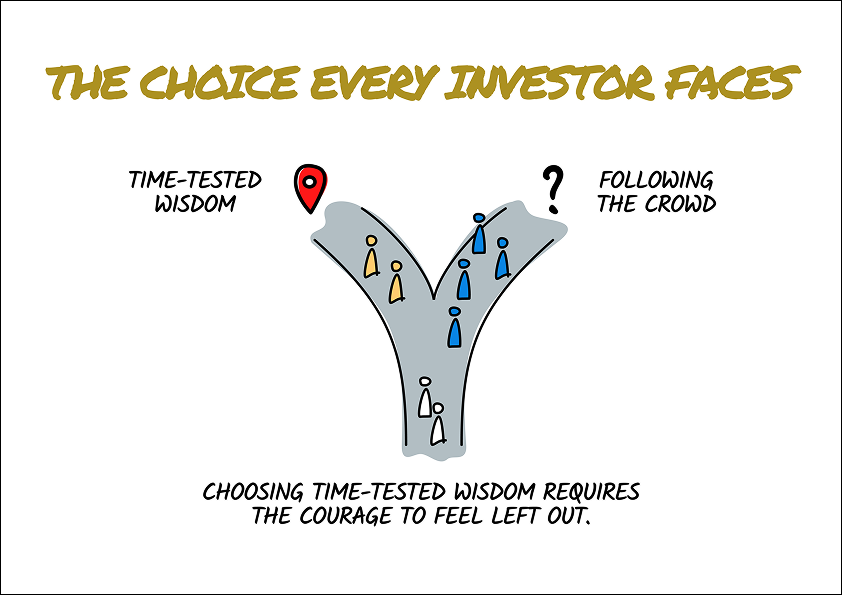
This brings us to a fundamental choice every investor faces. You can focus on what has always worked, or you can focus on what's working now. Established investors choose the former. Those chasing returns get distracted by the latter.
What has always worked? Global equities have consistently rewarded patient investors across every technological shift. Whether it was railways, electricity, automobiles, computers, or the internet, the great companies adapted and thrived. The businesses that couldn't adapt were replaced by those that could.
Your diversified portfolio captures this innovation without requiring you to guess which specific companies will lead the next wave of innovation. You benefit from human ingenuity and progress without the stress of picking winners.
Every generation believes its current investment opportunity is different and revolutionary. The fundamentals of business growth and compound returns remain constant, even as the headlines change.
Established investors understand that what feels exciting today will likely be tomorrow's forgotten fad. They choose time-tested wisdom over trendy speculation.
The difficulty with trend-led investing is that it can encourage us to look backwards rather than forwards.
When an investment has already performed exceptionally well, it can feel obvious that it will continue to do so. The story becomes compelling, the headlines become more frequent, and it becomes increasingly difficult to sit on the sidelines while others appear to be making money.
But strong past performance doesn't tell us what will happen next.
An industry can genuinely have enormous potential while the individual investments within it fail to deliver the returns investors expect. A company can be changing the world and still be a poor investment if too much optimism has already been built into its share price.
This is one of the reasons trend-led investing can be so difficult. The underlying idea might be right, but the investment decision can still be wrong.
Evidence-based investing takes a different approach. Instead of asking, "What's going to be the next big thing?", it asks, "What does the evidence tell us about how markets work over the long term?"
That shift in mindset can make investing feel less exciting, but that's often the point.
The aim isn't to win every conversation about the latest investment opportunity. It's to build and maintain a portfolio designed to support your financial goals over decades.
If you're between 40 and 55, you're perfectly positioned to embrace this time-tested approach. You have both the time horizon and the life experience to choose wisdom over excitement.
Your 10 to 25 years until retirement means steady returns are more than enough for financial independence. You don't need to swing for the fences. Your peak earning years allow you to save consistently, and your time horizon enables you to weather temporary volatility.
More importantly, you have the maturity to see through the hype cycles. You've lived through enough "revolutionary" investment opportunities to recognise the pattern. You understand that what feels urgent and exciting today rarely has a lasting impact on long-term wealth building.
This combination of time and wisdom puts you in the sweet spot. You can choose to be content with feeling left out while others chase the latest trends. You can focus on what has always worked while others get distracted by what's working now.
Your future self will thank you for having the courage to stay invested in proven fundamentals rather than speculative bets. We're here to help you maintain this discipline. Sometimes the most courageous thing you can do is nothing at all.
The value of investments and any income can go down as well as up and cannot be guaranteed.
Sources
[1] S&P Dow Jones Indices, SPIVA® Institutional Scorecard Year-End 2025. Research comparing the performance of active managers with their respective benchmarks over different time periods.
[2] Vanguard Investor UK, Why diversification beats chasing the top stocks, 27 August 2025. Vanguard analysis of Bloomberg data comparing the ten largest holdings of the S&P Total Market Index as at 31 December 2010 and 31 July 2025.
This content is for information purposes and should not be treated as financial advice. We would always recommend speaking to a professional before making decisions regarding your wealth. The information contained in this blog post is based on 2plan wealth management Ltd’s current understanding of tax laws as at April 2025. These laws are subject to change at any time and 2plan wealth management Ltd cannot be held responsible for any decisions made as a result of this newsletter. Tax advice is not regulated by the Financial Conduct Authority
.


